I understand why many Americans support Donald Trump. I even empathize with them, to a point.
Frustration, economic anxiety, the lure of an outsider, or even plain ignorance — these are powerful forces that test how resilient — or how fragile — a society really is.
These forces may pave the way for social improvement, but they can also curdle into something uglier — the kind of unquestioning loyalty that authoritarian-leaning leadership thrives on.
Americans have never lived under an authoritarian regime. So they can easily mistake the early signs of authoritarian drift for business as usual — until they become impossible to ignore.
It won't happen to me, though. I can spot the patterns a mile away because I'm Cuban — born and raised in Cuba, not in Miami — and I know what it looks like when a society slides toward one-man rule.
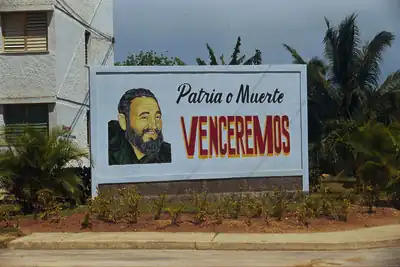
I escaped a machinery of fear, surveillance, and blind obedience — the kind that hides behind slogans like Patria o Muerte. That experience taught me to recognize a leader who thrives on those same tactics, wherever they hide.
I didn't run away to end up trapped in a sequel: Trump or Death.
The Past Haunts Me
During the Obama years, while Donald Trump was aggressively promoting his image as a patriot, I began to notice a sharp shift in America's socio-political landscape — a shift that stirred haunting echoes of both Cuban and American history.
By 2015, I was already recognizing the roots of ideological control taking hold in the U.S. — growing intolerance for dissent, demands for absolute political loyalty, and a rising culture of public shaming. And beneath it all lingered a not-so-disguised stench of racism. Allegiance to one man began to outweigh allegiance to principle — blind loyalty replacing reason as the new test of patriotism.
Back then, I was patriotically branded a communist for the first time — not because I embraced leftist ideology, but simply because I refused to support Trump. It was the first time in decades that silence felt safer than honesty. And that was eerily familiar.
Those were baby steps. Indoctrination never announces itself. It seeps in, disguising control as conviction.
I lived through it once under Fidel Castro — and I recognize the same pattern taking shape in America under Donald Trump.
Cuban Roots of American Indoctrination
I grew up in Cuba — how could I ignore the unnerving similarities between the passion I see in America today and the indoctrination I endured under Fidel Castro's revolution? The fervor surrounding Trump's movement mirrors the blind loyalty Castro demanded.
Back in Cuba, control seeped into every aspect of daily life: neighbors spied on neighbors, loyalty to Castro was mandatory, and questioning the revolution could cost you your future — and your children's future. Religion was blamed for moral decay, dissent was crushed, and universities were reserved for the obedient.
We had to pretend. To question was dangerous. To think for ourselves — unforgivable.
The Cubanization of America
Consider the fervent reaction to the 2020 U.S. presidential election. Claims of a stolen election became a litmus test for loyalty, with figures like Arizona House Speaker Rusty Bowers — a lifelong Republican — publicly shunned for refusing to endorse baseless claims of fraud.
This divide went far beyond politics; it seeped into friendships, workplaces, and even churches — where disagreement often meant isolation.
A society once proud of its freedom and critical thought is now gripped by division, demands for devotion, and growing intolerance. For instance, school board meetings across America now resemble ideological battlegrounds, where clashes over critical race theory and book bans have sparked threats, censorship, and the demonization of educators — a chilling echo of Cuba's repression of intellectuals who dared to question the revolution.
Seriously, I never thought I would escape Patria o Muerte... only to face a similarly disgusting variant.

Misunderstanding Freedom
"A great many people think they are thinking when they are merely rearranging their prejudices." — William James
Indoctrination begins early. In Cuba, children were forced to pledge allegiance to Castro, chant slogans like We will be like Che, and ridicule peers from religious families. We were taught to ostracize and shame anyone who dared to dream of a life outside the revolution.
In Cuba, indoctrination was blunt — there was nothing to hide. The government controlled all information, eliminating even the possibility of comparison.
In America, the mask is shinier and trickier. Here, the illusion of choice exists — an endless flood of information creates the appearance of independent thinking. But hidden forces of misinformation are so powerful that they cancel out the benefits of this abundance, shaping beliefs just as effectively as outright censorship.
In America, the ideal of freedom is weaponized to prevent people from questioning authority. Freedom is twisted into a slogan for uncritical loyalty: freedom to consume, freedom to own guns, freedom to reject science, freedom to believe whatever suits a political agenda. Those who question this distorted version of freedom are branded as enemies of America.
This distortion transforms freedom into a cage — a cage of unquestioned beliefs, blind loyalty, and enforced conformity.
What's Next?
Indoctrination is a tool wielded by regimes and movements seeking unquestioning power, from Castro's Cuba to the loyalty politics taking hold in Trump's America. Recognizing it is the first step toward reclaiming true freedom — a freedom built on critical thinking, open dialogue, and the courage to question.
As someone who has experienced indoctrination firsthand, I urge Americans to look past the slogans, the division, and the demands for loyalty. Challenge your own beliefs. Seek truth beyond political soundbites. And remember, freedom is not obedience — freedom is the ability to think freely.